
How it works
From the sink to the drain, in seconds.
A food waste disposer, also known as a garbage disposal, sits under the sink, connected to the waste pipe. It grinds food leftovers into fine particles that flow away with the water: all that is left in the kitchen is a clean sink.
In everyday use
Four moves, no bin.
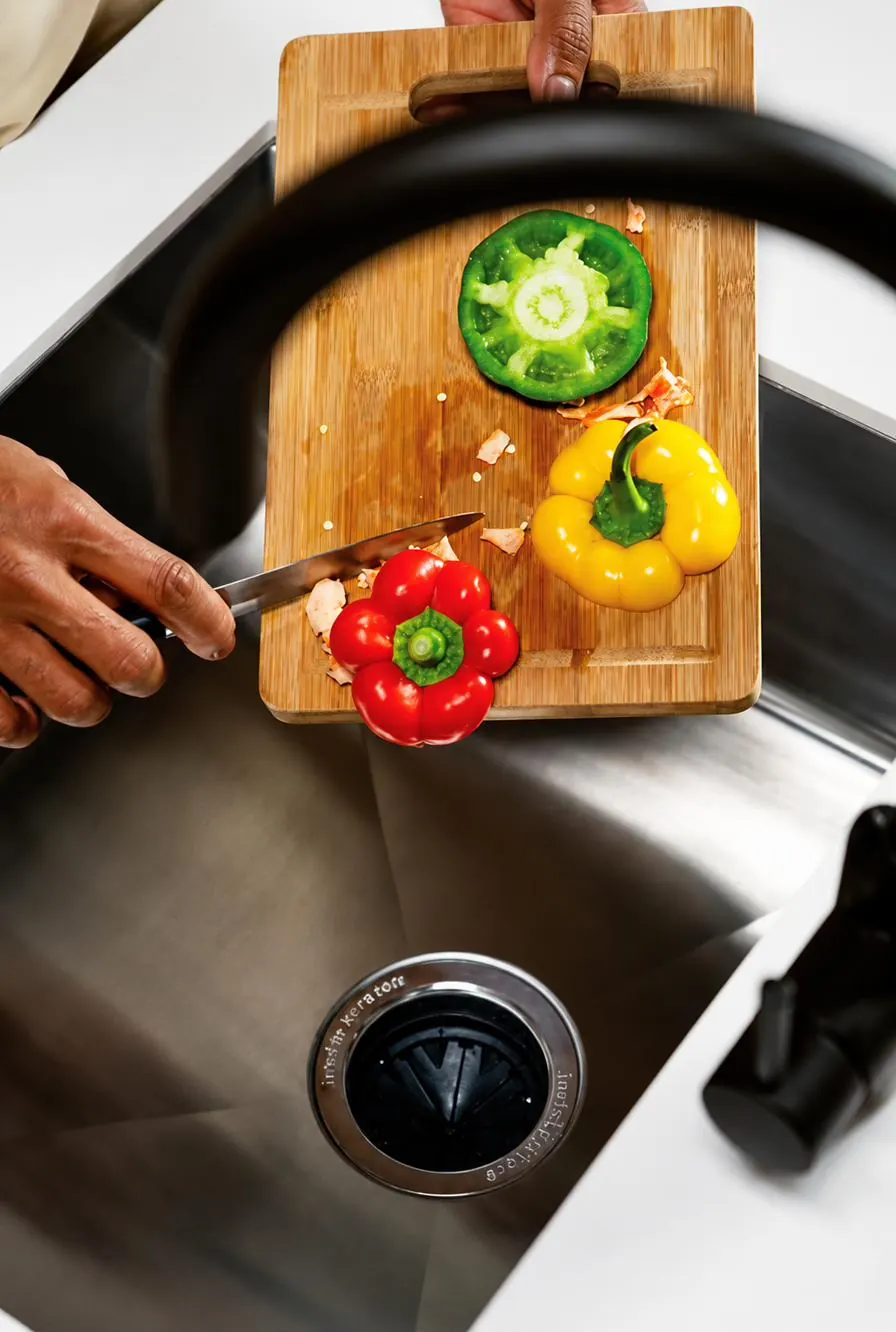
Turn on the cold water
A trickle of cold water helps the scraps go down and flow away.
Start the disposer
With the air switch, or with the remote control if you would rather leave the worktop untouched.
Feed in the leftovers
Straight into the disposer. The Easy Clean baffle holds back splashes and can be removed and cleaned whenever needed.
Switch off and let it run
When the sound changes and dies down, switch off and let the water run for a few more seconds.
This is what is left
Fine particles that go away with the water.
Leftovers become a fine grind that flows down the drain just like washing-up water.
Benefits
What changes, every day.
No wet waste
Food scraps no longer sit in the house waiting for collection day: you get rid of them while you cook or clear the table.
No smells, no insects
With no leftovers fermenting in the bin, the kitchen stays fresh and clean, even in summer.
More space, fewer bags
The cupboard under the sink is free again, and there are fewer compostable bags to buy, fill and carry down.
Modest consumption
The Italian distributor's data sheet indicates less than 3 litres of water per person per day and about 3-4 kWh a year; the most recent independent study measures 3.6 litres a day. Sources on the Environment page.
Stages and power
More stages, more power, a finer grind.
InSinkErator models have from 1 to 4 grinding stages. More stages means finer particles; more powerful motors also handle hard and fibrous scraps. The models higher up the range are quieter too.
What can be ground
What you can put into the disposer.
More grinding stages and more power make hard and fibrous scraps easier to handle. If in doubt, ask us: we will answer for your model.
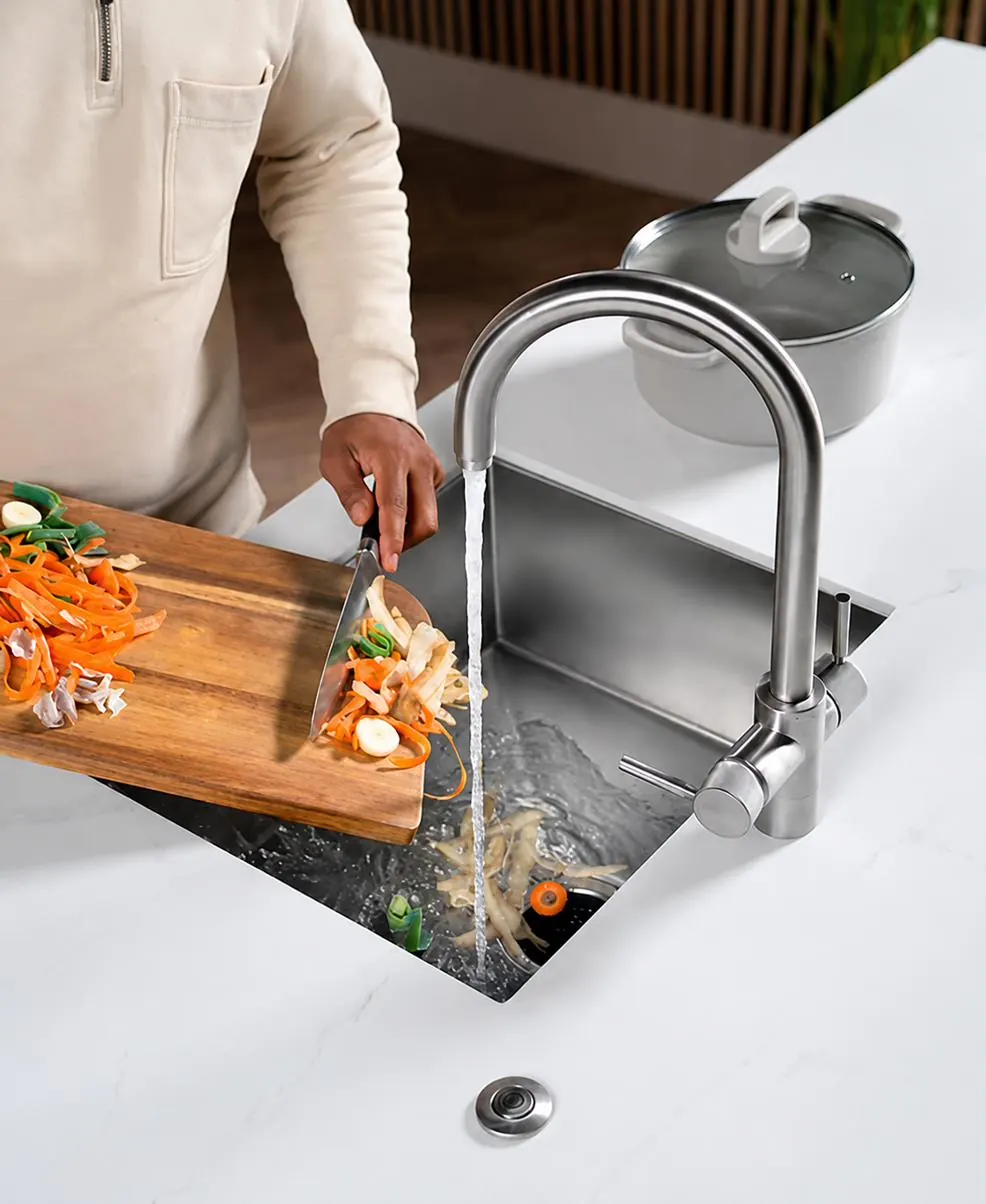
Yes, into the disposer
- Suitable: Food leftovers, cooked and raw
- Suitable: Fruit and vegetable peels and trimmings
- Suitable: Bread, pasta and rice
- Suitable: Coffee grounds
- Suitable: Eggshells
- Suitable: Fish bones and small bones
No, better avoided
- To be avoided: Large amounts of cooking oil and fat
- To be avoided: Large bones
- To be avoided: Shells from shellfish and molluscs
- To be avoided: Large amounts of very fibrous scraps (e.g. artichoke leaves)
- To be avoided: Plastic, glass, metal, paper and anything that is not food
- To be avoided: Hot water while grinding: always use cold water
Shared features
Built for an everyday kitchen.
980 ml chamber
Enough room for the leftovers of a family meal. The LC 50 goes up to 1475 ml.
Lift & Latch
A mounting system that simplifies fitting and maintenance, on the 550, 700, 750 and 1000 EC.
Easy Clean baffle
It cuts splashes and noise, and lifts out for cleaning in seconds.
Chrome air switch
Available on every domestic model: no electrical contact near the water.
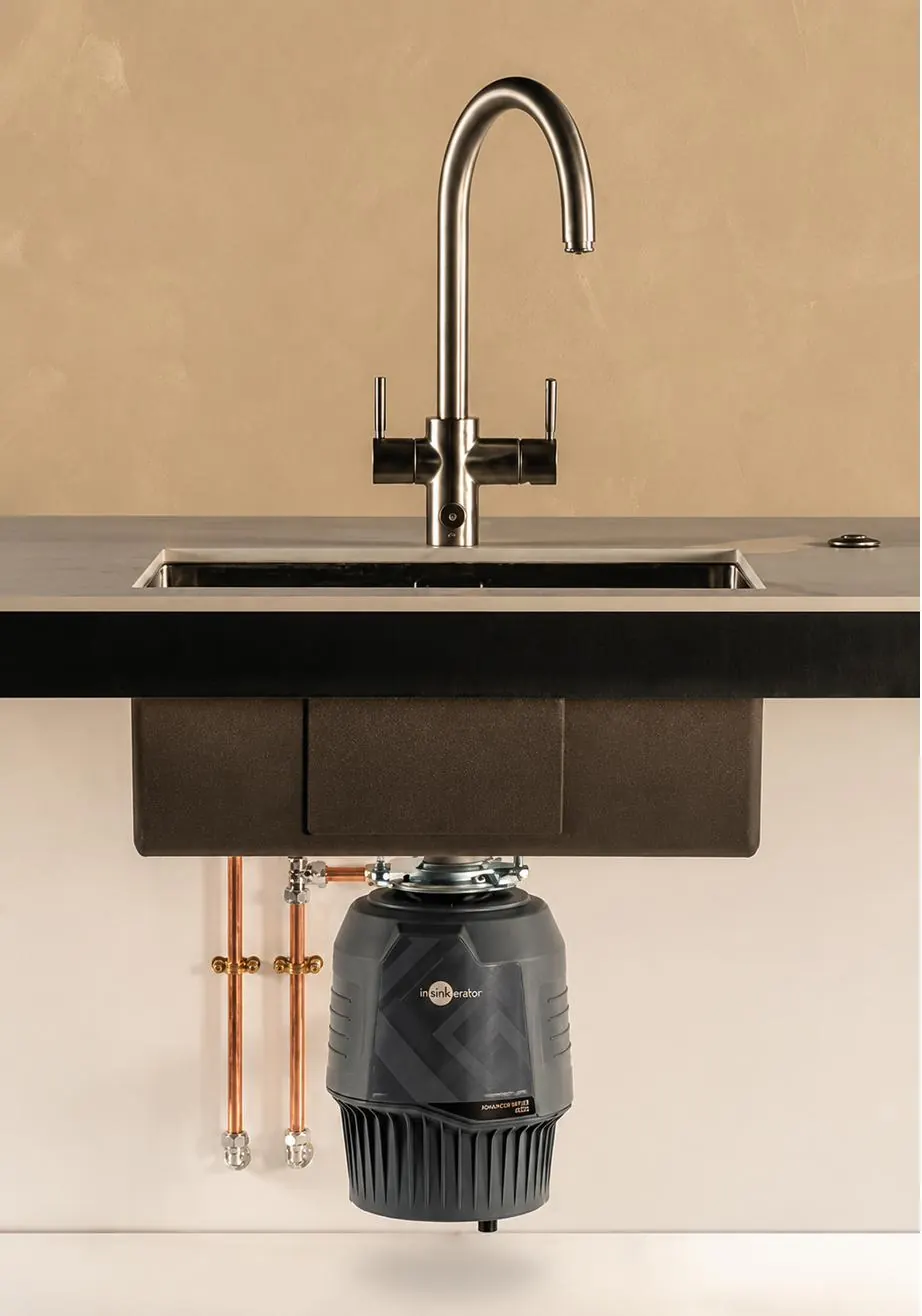
Do I need a special sink?
In most kitchens the disposer is fitted under the existing sink: a standard 9 cm waste is all it takes. For 14 cm square wastes there is a dedicated accessory. You also need a power socket and room in the cupboard under the sink. We check all of this during the survey that comes before installation.
Want to see it in your kitchen?
Write to us with a few details about your sink: we will recommend the right model and prepare a quote.